



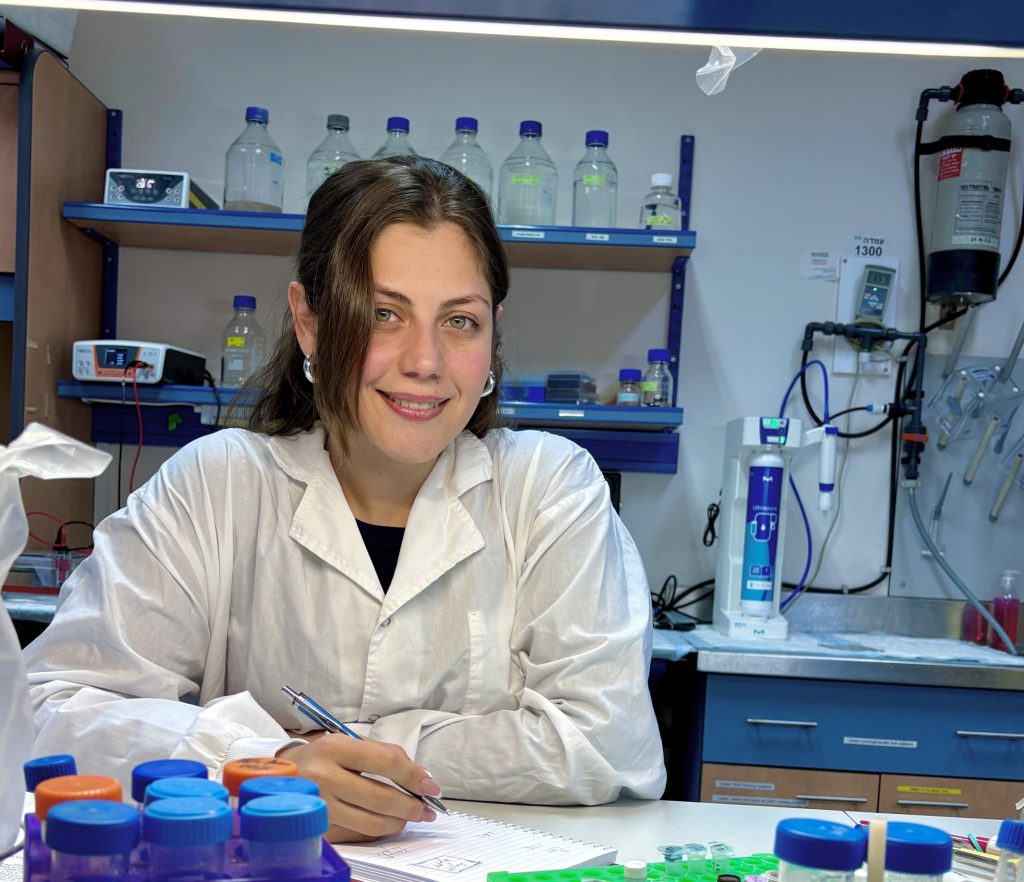
The winner of Paper of the Month for November 2025 is Laila Bishara from Prof. Nabieh Ayoub’s lab, whose article has been accepted for publication in Cell Death & Disease!
This is an impressive achievement that marks the culmination of a long period of in-depth research. To celebrate the occasion, we asked her to share a few insights about the scientific work in the lab, the discoveries presented in the article, and a bit about herself.
- Laila – tell us briefly about yourself: What did you study, what led you to this field, and what is your current role and workplace?
I am Laila, living in Haifa and married to Rony, I recently completed my PhD in Life Sciences with a focus on DNA damage response and cancer research. Inspired by the loss of close relatives, I have dedicated my career to understanding cancer’s complexities and developing more effective treatments. This mission led me to my PhD at the Ayoub Lab, where I focused on cellular responses to DNA damage and the mechanisms of carcinogenesis. Currently, I work as a research associate at Ayoub’s Lab, where I lead several ongoing projects. In addition to my research in the lab, I am actively seeking industry opportunities to apply my experience in translational research that directly improves patient care.
- What is the general focus of the Ayoub Lab?
In our lab, we investigate the cellular response to DNA damage. By exploring these mechanisms, we aim to identify novel regulators and uncover new pathways within the DNA damage response and repair processes, critical mechanisms that preserve genome integrity. Ultimately, our goal is to leverage these proteins to develop targeted cancer therapies.
- Tell us about the winning article: what was the central research question, what did you discover, and what was exciting or surprising during the process?
Our primary research question addressed how cells decide between the two major double-strand break (DSB) repair pathways: non-homologous end-joining (NHEJ) and homologous recombination (HR). This decision is critical for determining the cell fate and preventing carcinogenesis. We discovered that the previously uncharacterized protein C8orf33 acts as a crucial molecular gatekeeper that dictates this DSB repair pathway choice. We show that C8orf33 is recruited to damage sites and shifts the balance toward NHEJ. Mechanistically, we demonstrate that C8orf33 blocks the chromatin association of KAT8 acetyltransferase, thereby reducing the levels of histone H4 lysine 16 acetylation (H4K16ac). This reduction promotes recruitment of the NHEJ factor 53BP1 while simultaneously counteracting the recruitment of key HR factors, such as BRCA1 and Rad51, to DSB sites. One of the most surprising and exciting findings was observing that in the absence of C8orf33, DSB repair shifts uncontrollably to HR. This increase in HR leads to a massive loss of ribosomal DNA repeats, severely compromises genome stability, and ultimately results in cell lethality. This discovery underscores the vital importance of this epigenetic regulatory mechanism in maintaining cellular integrity and provides a novel perspective on the control of DNA repair pathway choice.
- What is the significance of your discovery? What future directions or applications could be developed from here?
The significance of our discovery lies in the fact that we are the first to characterize the molecular role of C8orf33 in DSB repair, a finding that establishes it as a potential target for precision cancer therapies. Interestingly, C8orf33 is overexpressed in multiple cancer types and actively suppresses HR repair pathway of DSBs. This opens an exciting translational direction: we hypothesize that such tumors exhibit HR deficiency, which may render them particularly sensitive to PARP inhibitor treatment, a well-known drug that targets HR-defective cancers. In the coming years, we hope this discovery could significantly impact the field by expanding the scope of patients who may benefit from PARP inhibitors beyond those with canonical BRCA mutations, positioning C8orf33 as a vital biomarker in the advancement of personalized and precision medicine.
- What are your aspirations going forward in your career?
I aim to apply the expertise I gained during my PhD to advance our understanding of cancer biology. My goal is to uncover novel disease mechanisms and help develop innovative therapeutic strategies that can be translated into effective clinical treatments.
⬅ Link to the article:
https://www.nature.com/articles/s41419-025-08194-8
⬅ Link to Prof. Nabieh Ayoub page:
https://biology.technion.ac.il/en/member/ayoub/
⬅ Link to the Ayoub Lab website: