



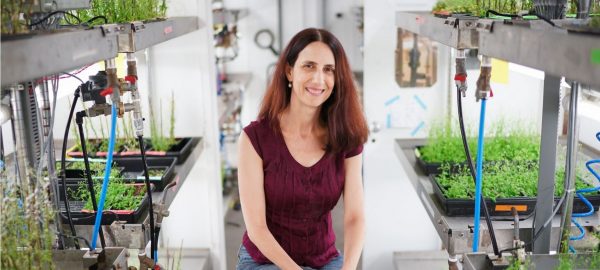
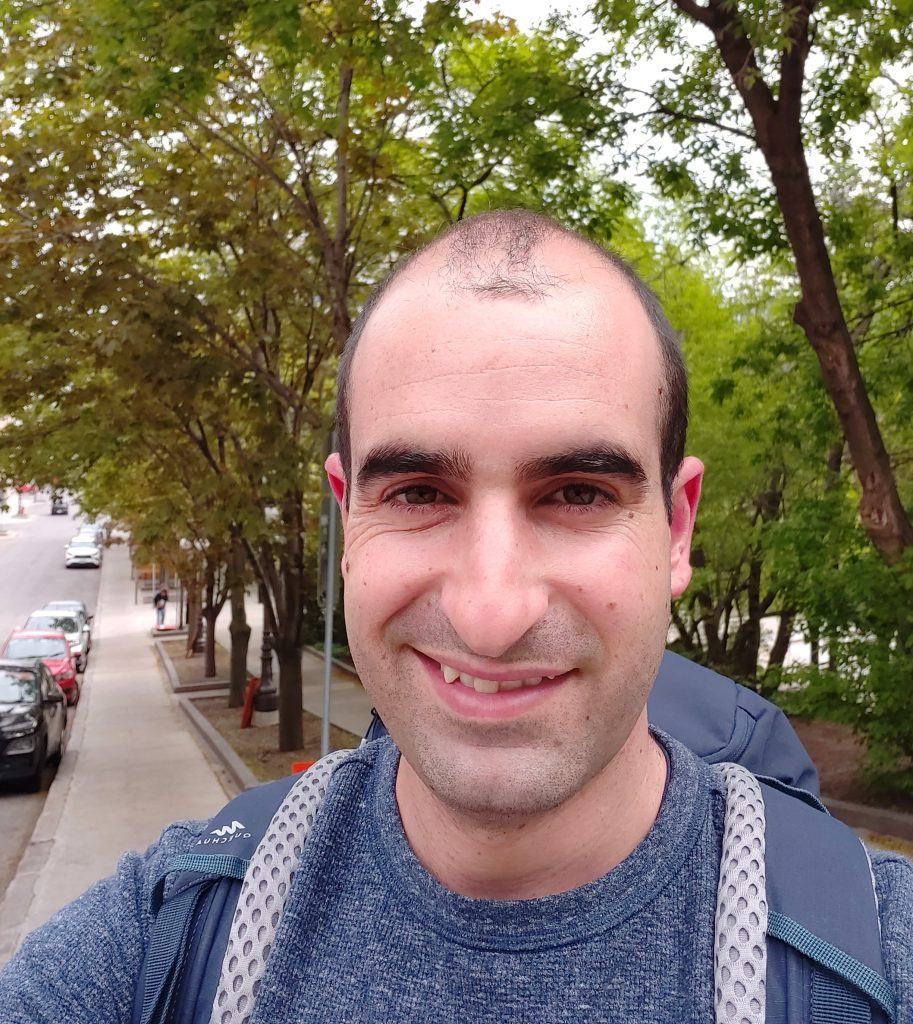
The winner of Paper of the Month for June 2026 is Ran Tahan from Prof. Debbie Lindell’s lab, whose article was published in Science Advances.
This is an impressive achievement that marks the culmination of a long period of in-depth research.
To celebrate the achievement, we asked Ran to tell us a little about the research, the journey that led to it – and life beyond the lab.
Hi Ran! Could you introduce yourself in a few words?
I completed my Bachelor’s degree at the Faculty of Biology at the Technion, where I also met my wife, Eden. During my studies, I conducted a research project in the lab of Prof. Debbie Lindell focusing on the characterization of a gene in cyanophage – viruses that infect cyanobacteria. This project subsequently evolved into my Master’s thesis. I then transitioned into my Ph.D., which investigates the genes that enable cyanophages to take over marine cyanobacteria. Today, as I near the completion of my PhD and prepare for a postdoctoral position, I am also busy being a dad to sweet Carmel.
What does the Lindell Lab focus on?
Cyanobacteria are important primary producers in the oceans. The Lindell lab studies the interaction between cyanobacteria and cyanophages to understand how cyanophages impact cyanobacterial abundance, physiology and evolution. Research in the Lindell lab include a wide range of topics, such as the fundamental characterization of infection traits, molecular mechanisms driving host cell takeover, and mechanisms of resistance to infection. Additionally, we conduct studies investigating cyanophage distribution and infection patterns in the oceans and understanding the environmental conditions that affect them.
Tell us about your current research. What was the main goal of the study, and what did you discover?
This paper is the outcome of a close collaboration with the Weitz lab (University of Maryland). The Weitz lab previously developed a mathematical modeling framework to analyze how viral populations accumulate over multiple rounds of infection and inferred what was happening inside individual cells including variation in the timing of the cell lysis when new viruses are released. In other words, gaining single-cell information from a population data.
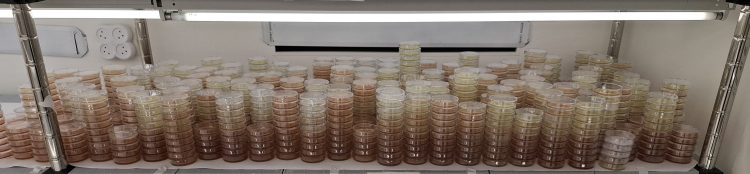
To test those model predictions, we developed a single-cell experimental assay that directly measured infection outcomes in individual cells using an ecologically relevant marine cyanophage-cyanobacteria pair. The results showed that the model predictions are incredibly accurate, revealing a substantial variation in the timing of the cell lysis. Moreover, we were able to link this variability to variability in viral progeny production showing a surprising new relationship between how long a virus remains inside a cell and how many progenies it produces.
Why is this discovery important?
We inferred and quantified ecologically meaningful time to viral lysis variability in a globally relevant cyanophage. Furthermore, we have shown that it is possible to accurately infer heterogeneity in viral infection traits at single-cell scales from population-scale dynamics. This inference approach helped determine that variation in the time to viral lysis is a major contributor to realized variation in viral progeny production. We anticipate that quantifying the variability of infection traits in phages will help identify mechanistic principles underlying lysis timing variation and enhance the development of predictive models of viral impacts in therapeutic and environmental contexts.
What drew you to this lab and to your current research project?
I find phage biology fascinating. The ability to genetically engineer cyanophages and investigate the roles of their genes during the infection is what drew me to Debbie’s lab. This project was conceived when I met Marian, who was then a PhD student in the Weitz lab, at a conference where she presented her model and asked who could help test it. Although the idea for an experimental assay to test variability in lysis time had emerged before meeting Marian, recognizing the model’s immense potential and our complementary capabilities gave me the motivation and drive to pursue this research.
What do you enjoy doing when you’re not doing science?
Currently, I am mostly busy being a dad, but in my free time, I love hiking and running, and I am also a plant enthusiast.
When you grow up, what do you want to be? 😉
And on a more serious note – what are your plans for the next stage of your career?
I plan to continue researching bacteriophages and am currently preparing for a postdoctoral position in Germany.
➡ Read the full article: https://www.science.org/doi/10.1126/sciadv.aed6456#sec-4
➡ Visit Prof. Debbie Lindell’s page: https://biology.technion.ac.il/en/member/lindell/
➡ Visit the Lindell Lab website: https://lindelltechnion.wixsite.com/lindell-lab