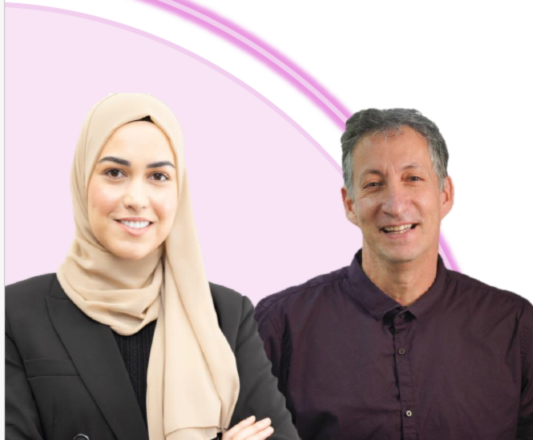



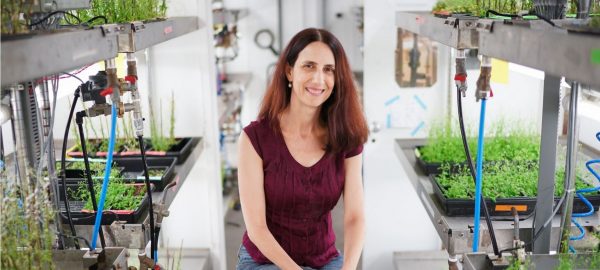
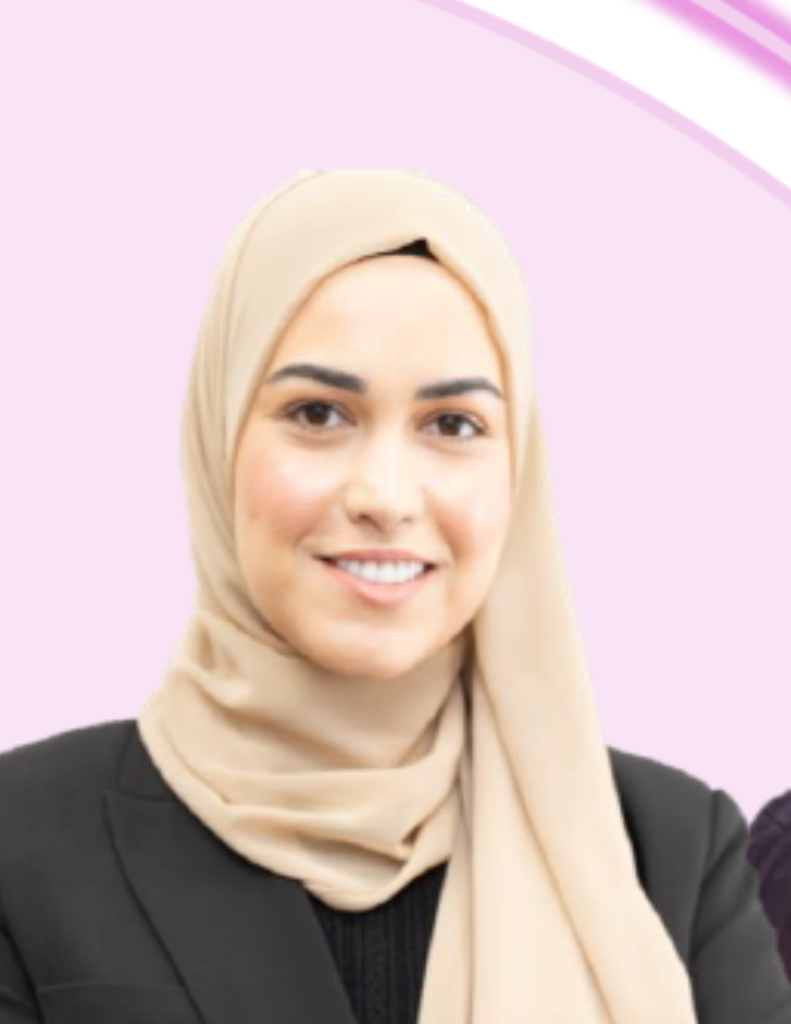
The Paper of the Month award for January 2026 goes to Layla Saied from Prof. Oded Kleifeld’s lab, for her article published in Molecular Life Sciences.
This impressive achievement reflects the culmination of a long and in-depth research journey.
To mark the occasion, we spoke with Layla about the study, the path that led to its publication, and life beyond the lab.
Hi Layla! Could you introduce yourself in a few words?
I was born and raised in Nahf. I began my academic journey with a joint B.Sc. in Medical Sciences and Biology at the University of Haifa, where I fell in love with research and realized this was the path I wanted to pursue. I continued to an M.Sc. in Cancer Research, and for my Ph.D., I transferred to Prof. Oded Kleifeld’s laboratory in the Faculty of Biology at the Technion, focusing on protease research. Currently, I am a postdoctoral researcher in Prof. Michael Glickman’s lab.
What does the Kleifeld Lab focus on?
The Kleifeld Lab operates at the forefront of protease research, exploring the intricate world of proteolysis to uncover its pivotal roles in cellular systems, health, and disease. The lab specializes in defining protease substrate specificity and discovering novel substrates using state-of-the-art quantitative proteomics. By integrating advanced methodologies in cell biology, biochemistry, and bioinformatics.
Tell us about your current research. What was the main goal of the study, and what did you discover?
The main goal was to explore the functions of the protease DPP9. In collaboration with the Geiss-Friedlander group at the University of Freiburg, we mapped the physiological interactome of DPP9 in cells using TurboID proximity labeling and quantitative proteomics. Beyond confirming known interactors like DPP8, our quantitative mapping revealed strong novel enrichments in pathways controlling autophagy, mRNA decay, and ubiquitin signaling. Crucially, we demonstrated that DPP9 physically disrupts the assembly of key regulatory complexes, including BRISC and CYLD–SPATA2. Ultimately, our findings establish that DPP9 functions as an active structural scaffold that directly modulates ubiquitin signaling architecture.
Why is this discovery important?
Conceptual Shift in Research: We demonstrated that DPP9 is not merely ‘biochemical scissors’ cleaving proteins, but acts as an essential structural scaffold that organizes and regulates cellular complexes and signaling pathways.
More Precise Drug Design: The findings prove that blocking only the catalytic active site of a protease is insufficient. Future therapeutic strategies must target structural scaffolding roles alongside enzymatic activity to develop safer and more effective drugs.
What drew you to this lab and to your current research project?
What drew me to the lab and this project was the drive to understand protein biochemistry at a deeper level—to explore not just what a protein does, but how its structural and biochemical mechanisms serve its biological function. It was a perfect opportunity to combine deep biological questions with cutting-edge methodologies like quantitative proteomics and proximity labeling.
What do you enjoy doing when you’re not doing science?
In my free time, I love hiking in nature and spending quality time with my family.
When you grow up, what do you want to be? 😉
To be working in my dream job!
And on a more serious note – what are your plans for the next stage of your career?
Looking ahead, my goal is to continue leading impactful research while stepping out of my comfort zone, mastering new technologies, and expanding my scientific toolkit. I aim to transition into a key role in biotech, pharma, or advanced research—taking responsibility for complex projects, translating biochemical insights into practical solutions, and growing alongside an inspiring team.
➡ Read the full article: https://link.springer.com/article/10.1007/s00018-025-06021-z
➡ Visit Oded Kleifeld’s page: https://biology.technion.ac.il/en/member/kleifeld/
➡ Visit the Lab website: https://oklab.net.technion.ac.il/